
When Far-Red Helps, and When it Backfires
Far-red light has become one of the most talked about tools in controlled environment agriculture. Used properly, it can improve canopy penetration, influence flowering, and even increase yield. Used poorly, it can lead to stretch, uneven growth, and reduced crop quality.
Like most things in cultivation, the difference comes down to how, and when, you use it.
What Far-Red Actually Does
Far-red light (700–750 nm) sits just outside the traditional photosynthetically active radiation (PAR) range. For years, it was largely ignored. That changed when growers started seeing how it interacts with plant photoreceptors, especially phytochrome.
In simple terms, far-red influences how plants interpret their light environment.
Playing a key role in shade avoidance responses, stem elongation, leaf expansion, and flowering signals in photoperiod crops.
Where Far-Red Helps
Improving Canopy Penetration
In dense canopies, upper leaves absorb most of the PAR light, leaving lower sites underlit.
Far-red photons pass deeper into the canopy, helping drive photosynthetic activity below the top layer.
What this means in practice:
- Better lower canopy productivity
- More uniform development across the plant
- Potential yield improvements without increasing overall intensity
Driving Flowering Responses
In photoperiod-sensitive crops, far-red can influence the transition to flowering by shifting the phytochrome state.
Strategically applied far-red can:
- Accelerate flowering initiation
- Help standardize crop timing
- Improve scheduling consistency in commercial operations
Increasing Leaf Expansion
Far-red can promote larger leaf surface area, which can:
- Improve light interception
- Support early-stage biomass accumulation
This is particularly useful in vegetative stages—when building canopy quickly matters.
When Far-Red Can Backfire
Excessive Stretch
Unwanted stretch and weak stocks are the most common complication of using far-red improperly.
Too much far-red, or applying it at the wrong stage, can trigger strong shade avoidance responses. The result: longer internodes, weaker plant structure, and lower density in flowering crops.
In crops where compact morphology matters (like cannabis or ornamentals), this can directly reduce quality and market value if applied incorrectly.
The Real Question: Strategy, Not Spectrum
Far-red isn’t inherently good or bad. It’s situational. When it’s built into a fixed spectrum, the real decision happens upfront. The growers seeing consistent results aren’t adjusting far-red on the fly. They’re selecting a spectrum that aligns with how they grow.
That means choosing a fixture where the far-red component supports your PPFD and DLI targets, not competes with them. It also means considering crop type and production goals before installation, not after.
If you’re evaluating far-red, the focus should be on fit. A well-balanced spectrum should support canopy development without pushing excessive stretch or weakening plant structure. For growers prioritizing speed and early canopy formation, a stronger far-red presence can help. For those focused on tight internodes and dense flower development, a more moderate approach is often the better choice.
Because you can’t adjust it mid-cycle, the margin for error is smaller. That’s why it’s important to look beyond output numbers and consider how the spectrum performs in real crop conditions. Plant response will tell you quickly if the balance is right.
At its core, far-red is a precision tool, even when it’s fixed. Used in the right proportion, it can support canopy performance, influence flowering, and contribute to yield. If the spectrum is not aligned to your goals, it can just as easily work against you.
The difference isn’t whether far-red is included. It’s whether it’s the right fit from the start, so choose a lighting provider that has done the research to develop a far-red spectrum that works.
Aelius LED’s REDD Spectrum
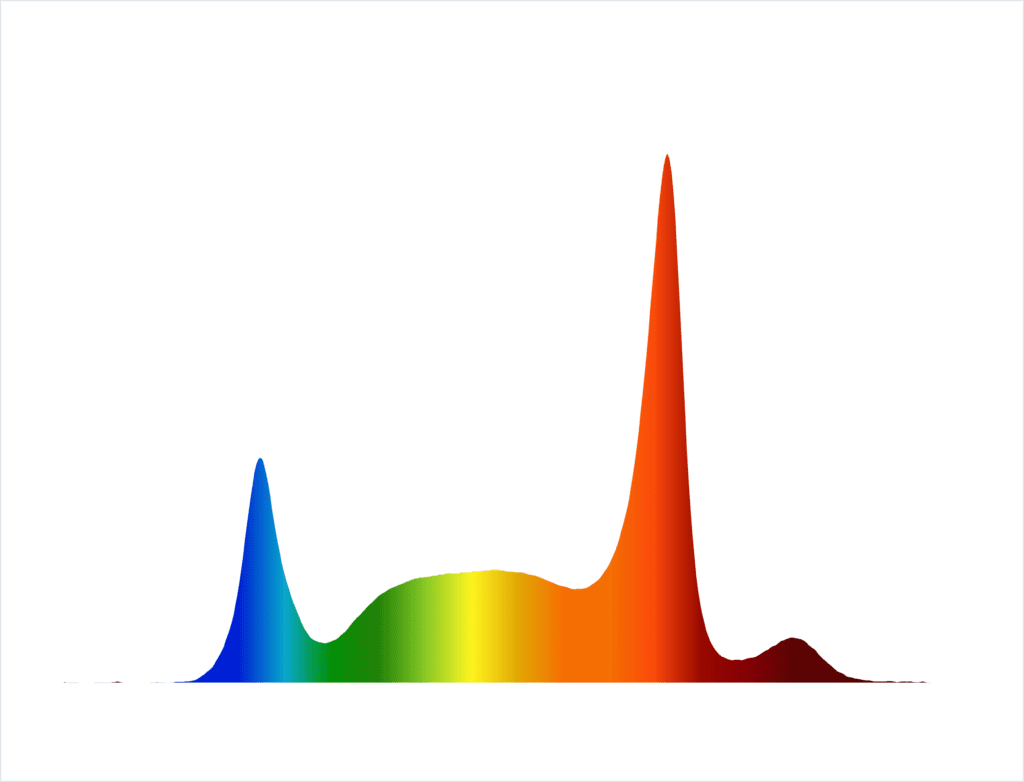
Aelius LED’s REDD Spectrum is a full-cycle, broad-spectrum white LED with targeted red and far-red enhancement. It features a distinct blue peak around 450 nm to support vegetative growth and structural control, a smooth green-yellow band for deeper canopy penetration, and a dominant deep red peak near 660 nm to drive photosynthesis and flowering performance. A smaller far-red component beyond 700 nm is intentionally included to influence phytochrome responses and support flowering signals. Overall, it is a red-dominant spectrum designed to deliver consistent performance without the need for spectral adjustment. This spectrum was specially designed for flowering and greenhouse cultivation.
About Aelius LED
Aelius LED is a global supplier of premium Horticultural LEDs for all stages of a plant’s life cycle. Aelius aims to help cultivators worldwide realize the true genetic potential of their crops by providing results-driven Horticultural LEDs designed to master commercial cultivation. Aelius LED is dedicated to the discovery of new technology and contributing to growth of the controlled environment agriculture industry.
We have extensive experience helping growers secure the best rebate opportunities across the country, and we can do the same for you.