
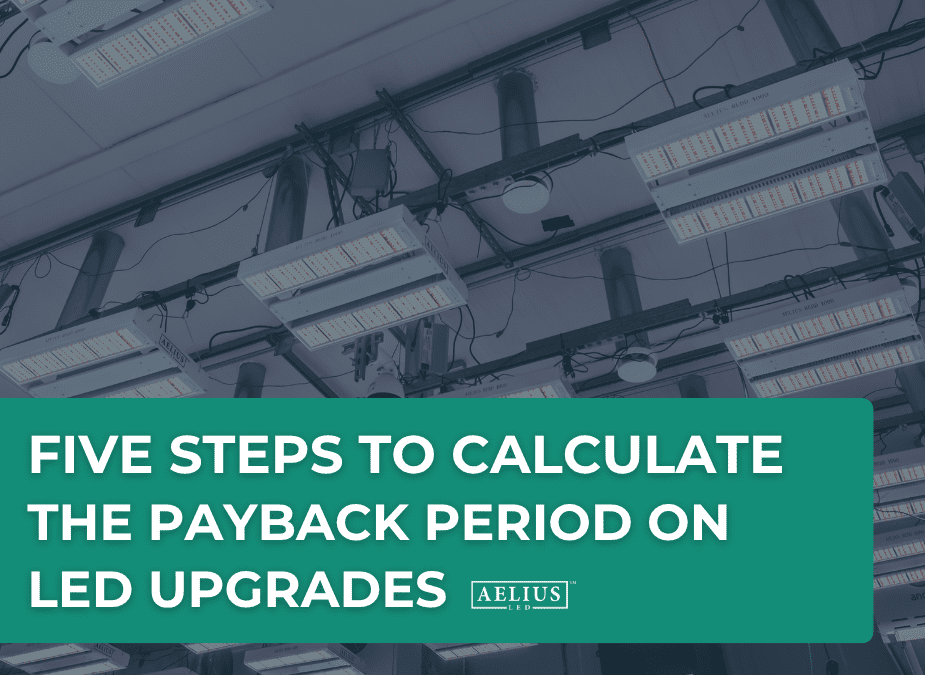
Five Steps to Calculate The Payback Period on LED Upgrades
Switching from legacy lighting to LED can improve efficiency, reduce operating costs and support better crop consistency — but for most growers and business owners, the real question is simple: how long is the payback period on LED upgrades?
This is a question we get asked often as an LED lighting company, and that’s when it’s time to dive into payback period.
What is a Payback Period
The payback period tells you how long it takes for the savings from your LED upgrade to recover from the initial investment. It is one of the fastest ways to evaluate whether a retrofit makes financial sense for your operation.
Calculating your Payback Period on LED Upgrades
The payback formula is simple:
Payback Period = Total Upgrade Cost ÷ Annual Savings
If your LED upgrade costs $100,000 and saves you $25,000 per year, your payback period is: $100,000 ÷ $25,000 = 4 years
Follow the five steps below to ensure a properly calculated payback period on LED upgrades.
Step 1: Calculate Your Total Upgrade Cost
Start with the full installed cost of the project, not just the fixture price.
This may include:
- LED fixtures
- Mounting hardware
- Controls or dimming systems
- Electrical upgrades
- Installation labour
- Freight
- Commissioning
If rebates are available, subtract those from the total cost to get your net project cost.
Example:
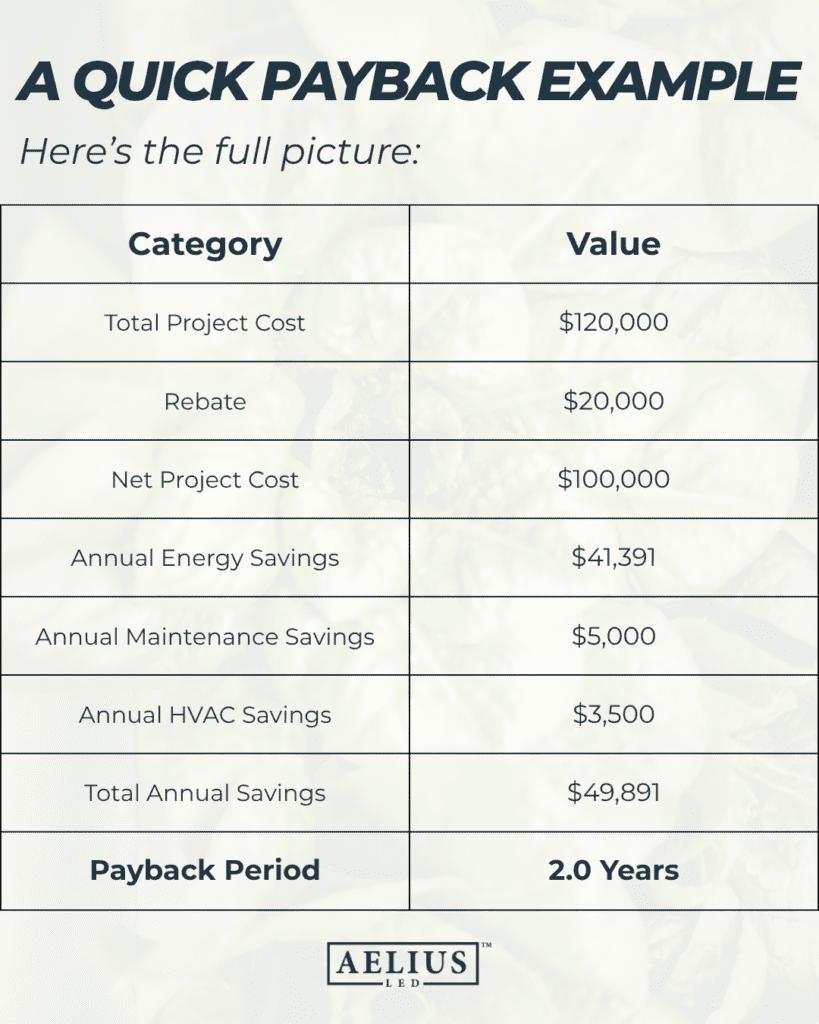
- Fixture and installation cost: $120,000
- Utility rebate: $20,000
- Net upgrade cost: $100,000
Step 2: Estimate Annual Energy Savings
The biggest source of savings usually comes from reduced power consumption.
Use this formula:
Annual Energy Savings = (Old Wattage – New Wattage) × Operating Hours per Year ÷ 1000 × Electricity Rate
Example:
- Existing fixture load: 120,000 W
- New LED load: 75,000 W
- Difference: 45,000 W
- Operating schedule: 18 hours/day, 365 days/year
- Annual hours: 6,570
- Electricity rate: $0.14/kWh
Now calculate:
45,000 × 6,570 ÷ 1000 = 295,650 kWh saved annually
295,650 × $0.14 = $41,391 annual energy savings
That number gets attention real fast.
Step 3: Add Maintenance Savings
LED upgrades often reduce maintenance costs too.
With fewer lamp replacements, less fixture servicing, and reduced downtime, maintenance savings can add up over time, especially in commercial facilities where labour is not cheap and access can be annoying.
This may include:
- Fewer bulb replacements
- Lower labour costs for servicing
- Reduced disposal costs for old lamps
- Less production disruption
Example:
- Annual lamp replacement and labour costs under old system: $6,000
- Annual LED maintenance cost: $1,000
- Maintenance savings: $5,000/year
Step 4: Factor in HVAC Savings if Applicable
In some facilities, LEDs reduce heat load compared to HPS or other legacy systems. That can lower cooling demand and create additional operating savings.
This varies by environment, crop strategy, and HVAC design, so it should be estimated carefully. But if your existing fixtures are dumping excess heat into the room, it can be meaningful.
Example:
- Estimated annual cooling savings: $3,500
Step 5: Add Up Your Total Annual Savings
Now combine all the savings categories:
- Energy savings: $41,391
- Maintenance savings: $5,000
- HVAC savings: $3,500
Total Annual Savings = $49,891
Common Mistakes when Calculating a Payback Period on LED Upgrades
Using fixture cost only: If you leave out installation, controls, or electrical upgrades, your math is too optimistic.
Forgetting operating hours: Indoor farms, greenhouses, and veg rooms all run differently. Use your real schedule.
Overlooking maintenance and HVAC savings: Energy is not the whole story.
Assuming all LEDs perform the same: A cheaper fixture may lower upfront cost and reduce your payback period, but it’s important to make sure the fixture doesn’t underdeliver on efficacy, uniformity, reliability, and lifespan.
How Rebates Impact Payback
Rebates are one of the most overlooked factors in reducing payback period on LED upgrades.
In many regions, utility and government programs offer incentives to offset the cost of high-efficiency lighting systems. These programs are designed to reduce energy demand, which means indoor farms are often strong candidates.
What Types of Rebates Are Available?
Depending on your location and facility type, rebates may include:
- Per-fixture incentives (e.g., $100–$500 per fixture)
- Performance-based rebates (based on energy savings, $/kWh reduced)
- Custom incentive programs for large-scale projects
- Agricultural-specific programs for greenhouses and indoor farms
In Canada, programs like Save on Energy (Ontario) and BC Hydro incentives can significantly reduce upfront costs.

What Counts as a “Good” Payback Period?
That depends on the facility, the project scale, and your business goals.
In many commercial indoor farming projects:
- Under 3 years = very strong
- 3 to 5 years = often attractive
- 5+ years = may still make sense depending on crop value, rebates, and long-term operating goals
Payback Period vs ROI
These terms get tossed around like they mean the same thing. They do not.
- Payback period tells you how fast the project recovers its cost
- ROI (Return on Investment) tells you how much return the project generates over time
Payback is useful because it is fast and practical. ROI is useful because it gives a broader financial picture of the upgrade. A project with a slightly longer payback may still deliver better crop quality, improved uniformity, higher yields, or reduced risk – leading to an overall higher ROI.
Calculating a payback period on LED upgrades is a simple way to assess if it makes sense for your facility. When energy savings, maintenance reductions, rebates, and operational improvements are accounted for; the numbers become more compelling than cultivators expect.
And when the upgrade also improves light uniformity and crop consistency? That’s when the real ROI begins to show.
Aelius LED is Here to Lead the Way
Trust Aelius LED to help with the upgrade you deserve, because you only want to do it once. Contact us at sales@aeliusled.com for more info.
Why Aelius LED
Aelius LED is a global supplier of premium Horticultural LED grow light products for all stages of a plant’s life cycle. Aelius aims to help cultivators worldwide realize the true genetic potential of their crops by providing results-driven LED Light Fixtures designed to master commercial cultivation. Aelius LED is dedicated to the discovery of new technology and contributing to growth of the controlled environment agriculture industry.
We have extensive experience helping growers secure the best rebate opportunities across the country, and we can do the same for you.