
Photoinhibition: The Hidden Yield Killer No One Talks About
In controlled environment agriculture, light is treated as a primary lever for yield. Increase PPFD, push DLI, and production should follow.
But plant physiology doesn’t scale linearly with light input.
At a certain point, additional photons stop driving photosynthesis and start damaging the system responsible for it. This process is known as photoinhibition, and it’s one of the most overlooked limitations in high-performance growing.
What Photoinhibition Actually Is
Photoinhibition is defined as a light-induced reduction in photosynthetic capacity, primarily caused by damage to Photosystem II (PSII) which is the protein complex responsible for initiating the light reactions of photosynthesis.
Under excessive light:
- PSII reaction centers become overexcited
- Electron transport becomes saturated
- Excess energy leads to photooxidative stress
This results in direct damage to the PSII reaction center, particularly the D1 protein, which must be continuously degraded and rebuilt for the system to function properly.
In simple terms:
You’re overwhelming the plant’s ability to process light, and the machinery starts breaking down.
What Happens Inside the Plant
When absorbed light energy exceeds the plant’s photosynthetic capacity, several things occur:
1. Reactive Oxygen Species (ROS) Formation
Excess excitation energy leads to the formation of reactive oxygen species, which damage cellular structures and photosynthetic proteins.
2. PSII Inactivation
Photoinhibition is essentially a loss of PSII activity, meaning the plant’s ability to convert light into chemical energy declines.
3. Reduced Photosynthetic Efficiency
Key indicators like Fv/Fm (maximum quantum efficiency) drop, signaling reduced capacity for CO₂ assimilation and oxygen evolution.
4. Repair Cycle Bottleneck
Plants constantly repair PSII by replacing damaged D1 proteins—but under high stress, damage outpaces repair, leading to net losses in efficiency.
The Curve Nobody Talks About
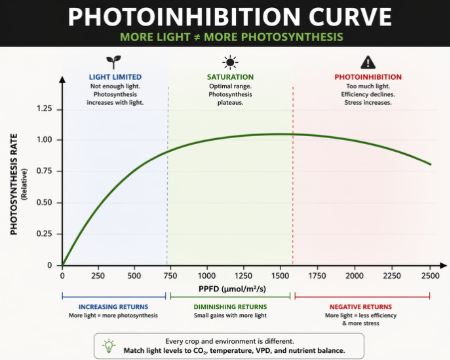
Photosynthesis follows a well-known light response curve:
- In low light → photosynthesis increases with light
- At saturation → it plateaus
- Beyond saturation → it declines due to photoinhibition
In other words:
There is a real, measurable point where more light reduces output.
Recent modeling across thousands of datasets shows that after a saturation point, photosynthetic rates can actively decline as irradiance increases, not just plateau.
Why This Matters in Controlled Environments
In theory, indoor and greenhouse environments should eliminate stress variables.
They often amplify photoinhibition risk:
- High, constant PPFD without natural fluctuation
- Limited CO₂ or nutrient bottlenecks reducing energy use
- Suboptimal temperature or VPD slowing metabolic processes
- Uniform top-lighting that overloads upper canopy leaves
When the plant can’t use the incoming energy, it doesn’t just ignore it, it pays for it physiologically.
The Hidden Cost: Efficiency Loss, Not Just Damage
Photoinhibition isn’t just about visible stress.
It shows up as:
- Lower-than-expected yield at high light levels
- Diminishing returns on energy input
- Reduced light-use efficiency (grams per kWh)
- Slower growth despite higher PPFD
At scale, this becomes an economic problem, not just a biological one.
Why “More Light” Keeps Failing
Because plants are not light-limited systems—they are system-limited systems.
Photosynthesis depends on:
- Carbon availability (CO₂)
- Enzyme activity (temperature-dependent)
- Sink strength (growth demand)
- Water and nutrient transport
If any of these lag behind, excess light becomes stress.
And when that happens, the plant shifts from photochemistry → photoprotection.
What Plants Do to Protect Themselves
Plants aren’t passive. They actively try to manage excess light through:
- Non-photochemical quenching (NPQ) → dissipating excess energy as heat
- Leaf angle adjustments
- Pigment changes
But these are defensive responses, not productive ones.
Every photon dissipated as heat is a photon not contributing to yield.
The Bottom Line
Photoinhibition is not a fringe concept, it’s a core limitation of photosynthesis.
- It happens in all photosynthetic organisms
- It increases with light intensity
- It directly reduces photosynthetic efficiency and yield
And most importantly:
It’s one of the clearest reasons why more PPFD doesn’t always mean more output.
Where This Leaves Growers
The goal isn’t to push light levels as high as possible.
The goal is to:
- Match light intensity to the plant’s metabolic capacity
- Optimize uniformity across the canopy
- Align PPFD with CO₂, temperature, and growth stage
Because at the end of the day:
If your plant can’t use the photons, you’re paying for stress, not growth.
About Aelius LED
Aelius LED is a global supplier of premium Horticultural LEDs for all stages of a plant’s life cycle. Aelius aims to help cultivators worldwide realize the true genetic potential of their crops by providing results-driven Horticultural LEDs designed to master commercial cultivation. Aelius LED is dedicated to the discovery of new technology and contributing to growth of the controlled environment agriculture industry.
We have extensive experience helping growers secure the best rebate opportunities across the country, and we can do the same for you.